Employment law is changing significantly, and for businesses, preparation will be just as important as understanding the law itself.
Employment law reform is no longer something businesses can afford to leave on the agenda for another day. With the Legge sui diritti del lavoro 2025 introducing a series of changes throughout 2026 and 2027, employers need to consider not only what their legal obligations will be, but also how those obligations will affect their day-to-day operations.
For many organisations, this will mean reviewing existing policies, reconsidering established practices and ensuring that managers are equipped to deal with workplace issues appropriately.
The challenge is not simply to achieve compliance. It is to understand what these changes mean in practice and to make the necessary adjustments before problems arise.
A changing landscape for employers
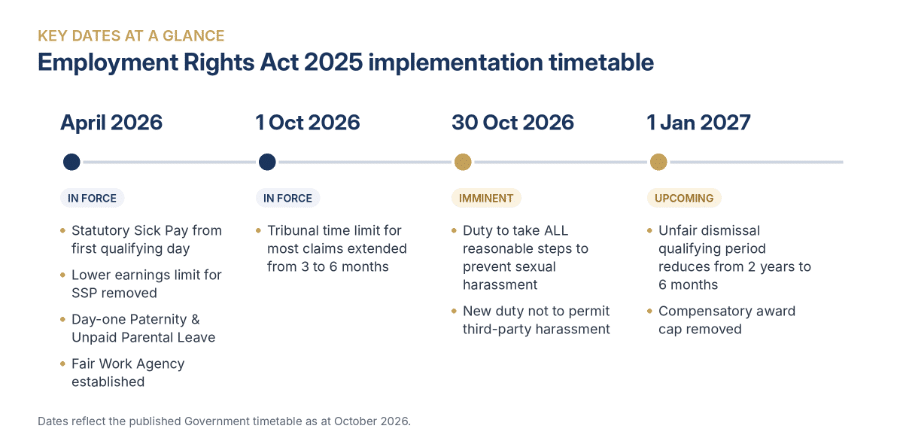
The Employment Rights Act 2025 represents a significant development in UK employment law. Rather than introducing every reform at once, the Government is implementing the changes in stages with several important measures already in force and others due to take effect over the coming months.
For employers, this phased approach provides an opportunity to prepare. However, it also means that keeping track of implementation dates and understanding which obligations apply at any given time will be essential.
Some of the most significant changes concern unfair dismissal, statutory sick pay, family leave, workplace harassment and the enforcement of employment rights. Each has practical implications for businesses, regardless of their size or sector.
1. Unfair dismissal: a greater need for robust procedures
One of the most notable forthcoming changes concerns the right to claim unfair dismissal.
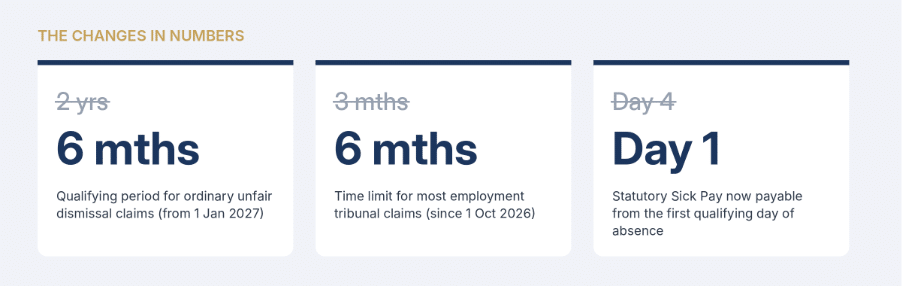
From 1 January 2027, the qualifying period of employment required to bring an ordinary unfair dismissal claim is due to reduce from two years to six months. The cap on compensatory awards for ordinary unfair dismissal is also due to be removed.
For employers, this is a particularly important development. Employees will become eligible for ordinary unfair dismissal protection much earlier in their employment making recruitment, probation and performance management processes all the more significant.
Businesses should consider whether their existing probationary periods provide sufficient opportunity to assess performance and suitability. Managers should also be confident in identifying concerns early, communicating expectations clearly and keeping appropriate records of performance discussions and decisions.
Where concerns arise, it is important that they are addressed promptly and fairly, rather than being allowed to continue until they become more difficult to resolve.
“A well-documented and consistently applied procedure is not simply good employment practice; it can also be an important safeguard against unnecessary disputes.”
2. Sexual harassment: prevention must be a genuine priority
Workplace harassment remains an important area of focus, with further employer obligations due to take effect on 30 October 2026.
The existing duty to take reasonable steps to prevent sexual harassment will be strengthened to require employers to take all reasonable steps. Employers will also face a new duty not to permit the harassment of their employees by third parties, such as customers or clients.
These changes reinforce an important principle: employers should not wait for a complaint before considering whether their workplace arrangements are adequate.
Policies are an important starting point, but they are not enough on their own. Businesses should consider whether employees understand what constitutes inappropriate behaviour, whether reporting channels are accessible and whether concerns are investigated effectively.
It is equally important to consider the practical realities of the working environment. For example, businesses whose employees regularly interact with customers, suppliers or members of the public should assess the risks of third-party harassment and consider what protective measures may be appropriate.
Training, clear reporting procedures, effective investigations and visible support from senior management all have a role to play.
“Ultimately, prevention needs to be reflected in the way an organisation operates, rather than existing solely within its employee handbook.”
3. Statutory sick pay and family leave: reviewing policies and payroll
A number of changes introduced in April 2026 have already affected employers’ responsibilities.
Statutory Sick Pay is now payable from the first qualifying day of sickness absence, subject to the applicable rules and the lower earnings limit has been removed. This extends eligibility to workers who were previously excluded because of their earnings and removes the previous waiting period.
Eligible employees can also take Paternity Leave and Unpaid Parental Leave from their first day of employment, removing the previous qualifying service requirements.
These changes make it important for businesses to ensure that their payroll systems, employment policies and internal procedures are up to date.
Employers should confirm that payroll calculations reflect the revised sick pay rules and that managers understand how to handle requests for family leave. Recruitment and onboarding processes should also accurately explain employees’ entitlements.
Although these changes may appear administrative, errors can have a direct impact on employees and expose businesses to avoidable complaints or disputes.
4. Employment Tribunal deadlines: time to review how disputes are managed
Since 1 October 2026, the time limit for bringing most employment tribunal claims has increased from three months to six months, subject to the applicable rules and exceptions.
This is an important change for employers because it extends the period within which certain workplace disputes may develop into formal legal claims.
It should not be interpreted as a reason to delay addressing complaints or resolving workplace issues. If anything, it reinforces the importance of dealing with concerns properly when they arise.
Employers should ensure that grievances, disciplinary matters and potential disputes are documented and handled consistently. Relevant records should be retained appropriately and any potential legal issues should be identified and escalated at an early stage.
A prompt and considered response can often help prevent a manageable workplace issue from becoming a more significant problem.
5. Enforcement and the importance of getting the basics righ
The Fair Work Agency was established in April 2026 as part of the wider reforms to employment rights enforcement.
For businesses, this is a further reason to pay close attention to compliance with fundamental employment obligations, including pay, holiday entitlement and statutory sick pay.
Employers should review their existing arrangements and ensure that they can demonstrate compliance where required. This includes maintaining appropriate records, checking payroll practices and ensuring that employment policies reflect the law as it currently stands.
Good compliance should not depend on an issue being raised or an inspection taking place. It should form part of the organisation’s ordinary management and administrative processes.
What should businesses be doing now?
With further changes approaching, employers should take a practical and structured approach to preparation.
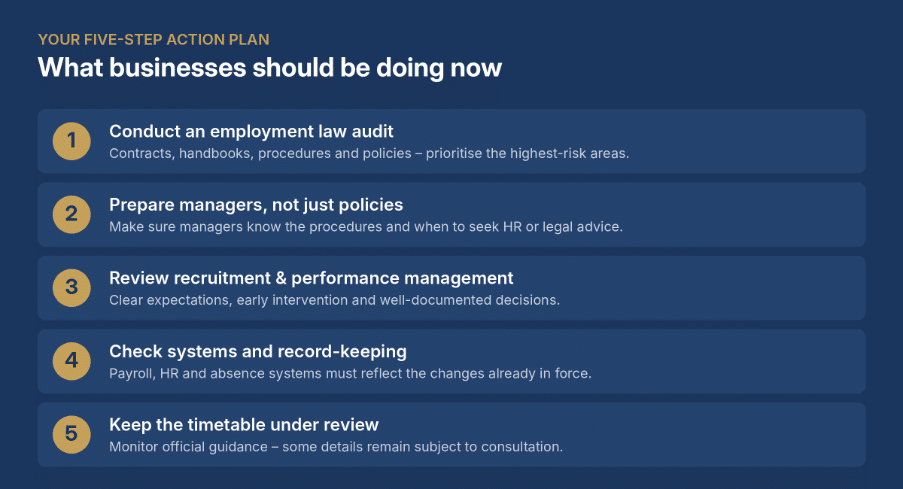
- Conduct an employment law audit. Review employment contracts, staff handbooks, disciplinary and grievance procedures, sickness absence policies, family leave arrangements and harassment policies. Identify where changes are required and prioritise the areas presenting the greatest legal or operational risk.
- Prepare managers, not just policies. Managers are often responsible for handling the situations most likely to lead to disputes. They should understand the relevant procedures, know when to seek HR or legal advice and be confident in applying policies fairly and consistently.
- Review recruitment and performance management. With the qualifying period for ordinary unfair dismissal protection due to reduce, businesses should ensure that expectations are communicated clearly, performance concerns are addressed early and decisions are properly documented.
- Check systems and record-keeping. Payroll, HR systems and absence management procedures should reflect the changes already in force. Records should be accurate, accessible and retained in accordance with applicable legal requirements.
- Keep the implementation timetable under review. Further reforms are scheduled for 2027 and some implementation details remain subject to consultation or change. Businesses should monitor official guidance and obtain advice where the implications for their organisation are unclear.
Looking ahead: compliance is only part of the picture
It is understandable that businesses may view employment law reform primarily as an additional compliance burden. However, there is also an opportunity to take a closer look at how employment practices operate in reality.
Clear procedures, well-trained managers and fair, consistent decision-making can help reduce disputes, improve employee confidence and create a more effective working environment.
Businesses do not necessarily need to overhaul every policy or process overnight. They do, however, need to understand where they stand, identify what needs to change and take action within the relevant timescales.
The most effective approach is to treat employment law compliance as an ongoing business responsibility, rather than a task to be revisited only when legislation changes or a problem arises.
“The key question for employers is not simply whether they know the law is changing, but whether their business is ready for those changes in practice.”
How can we help?
Navigating employment law changes can be challenging, particularly when businesses are balancing compliance with the practical demands of running an organisation.
At Ronald Fletcher Baker LLP, we advise on employment law matters and help businesses understand their obligations, manage risk and approach workplace issues with confidence.
If your business would benefit from advice on the latest employment law developments or would like assistance reviewing its existing policies and procedures, please get in touch with Adam Pavey via email a.pavey@rfblegal.co.uk or direct dial 020 7613 1402.

Adam Pavey
Partner di lavoro